
Mortgage renewal documents: what you need to switch lenders in Norfolk County
You’ve opened your mortgage renewal letter, and the rate isn’t what you were hoping for. Could another lender do better?
Maybe. But to a new lender, you’re a new customer. They’ll want to look at your income and your home before they approve anything.
So here’s what you’ll need to gather, whether you’ll be stress tested again, and how early to start. (Rules checked October 2026.)
Do you have to requalify when you switch lenders?
Your new lender still has to approve you. But you may not have to be stress tested again.
You usually skip the stress test if all three of these are true:
- You’re keeping the same balance. You’re not borrowing more.
- You’re keeping the same number of years left to pay it off (your amortization).
- You’re moving from one bank to another, or between other federally regulated lenders.
That’s called a straight switch. On November 21, 2024, OSFI, the federal organization that regulates banks, dropped the stress test for these switches. In December 2024, Ottawa extended the rule to some switches into other kinds of lenders too.
Did you put less than 20% down when you bought? Then your mortgage is most likely insured. Insured mortgages don’t need the stress test either when you switch at renewal. Your original mortgage papers will tell you which kind you have.
Thinking of a credit union or another non-bank lender? The rules can work differently depending on the lender and how the mortgage is insured, so check whether your switch qualifies before you apply.
One thing doesn’t change. Skipping the stress test isn’t the same as skipping the checks. OSFI still expects your new lender to review you the way it would review anyone applying for a brand-new mortgage, and that lender may use different rules than your current one.
What documents will a new lender ask for?

Each lender has its own list. But these are the documents most often requested for a switch:
| Document | What to bring | Why they want it |
|---|---|---|
| ID | Government-issued photo ID | To confirm who you are |
| Your mortgage | Renewal letter or latest annual mortgage statement | Your balance, rate and renewal date |
| Property tax | Your current tax statement | Your home’s tax details |
| Income, if you’re employed | Recent pay stub and a letter from your employer | Your pay and how long you’ve had the job |
| Income, if you’re self-employed | Your last two notices of assessment from the CRA | The income the CRA has on file |
| Home insurance (some lenders) | Your policy details | Proof the home is insured |
Everything you send should be recent and complete. A pay stub from last spring, or a statement with a page missing, only delays your application.
A few other things may come up along the way:
- A payout statement. This shows what it takes to pay off your current mortgage. Your new lender, your lawyer or a transfer service usually requests it from your current lender. Sometimes you have to ask for it yourself.
- An appraisal. The lender may want to confirm what your home is worth. Find out who pays for it.
- Rural property details. Plenty of homes around Norfolk County sit on acreage or run on a well and septic system. Depending on the property and the lender, more information may be needed. My rural and acreage mortgages page covers what lenders look at.
What changes if you’re self-employed or your income is seasonal?
A bit more paperwork.
Lenders often use your tax documents to work out your income. Business deductions can make that income look different from your business’s overall cash flow.
Expect to show your last two notices of assessment. Many lenders also want to see that you’ve been self-employed for two years or more.
The rest depends on how your business is set up:
- Incorporated? Bring your company’s financial statements, plus proof of the salary or dividends you pay yourself.
- Sole proprietor? Bring your T1 tax returns with the business pages.
If your income is seasonal, bring records for the whole year. Your busy months alone won’t tell the full story.
My self-employed mortgages page goes through this in more detail.
What if you want to borrow more or refinance?
Straight switch
- Same balance
- Same repayment period
- Stress test: usually no
- Appraisal: sometimes
Refinance
- Borrow more or add years
- Stress test: yes
- Appraisal: likely
- Full new application
Stress test rules apply to federally regulated lenders.
Then it’s not a straight switch. It’s a full new application, and federally regulated lenders will stress test you.
That’s true whether you’re borrowing more for a renovation, paying off other debts, or taking money out of your home. It’s also true if you add years to your mortgage to lower the payment. The lender will likely want an appraisal too.
My refinance and home equity page shows how much you might be able to borrow and what it costs over time.
Why do your documents need to match?
A good credit score doesn’t prove your income. Your documents do.
So the numbers on your application need to match your pay stubs, statements and tax papers.
Spotted a mistake? Let me know right away. It happens: a pay figure typed wrong, a small car loan you’d forgotten about. As a licensed mortgage agent, I have to tell a lender if I think information in an application isn’t accurate, so we sort it out before anything is submitted.
Never change a document or leave a debt off to make the numbers work. That’s fraud, and it can cost you the approval.
Is it easier to stay with your current lender?
Usually, yes. There’s less paperwork.
Banks and other federally regulated lenders have to send your renewal offer at least 21 days before your term ends. If you don’t respond, your mortgage may renew on its own.
But easier doesn’t always mean cheaper. Switching can come with fees, such as:
- a discharge fee, to remove your old mortgage from your property title
- registration or transfer fees
- an appraisal fee
- administration fees
Compare the full cost before you decide. On my renewal and switch page, I explain how I compare your current offer against other lenders, fees included.
When should you start?
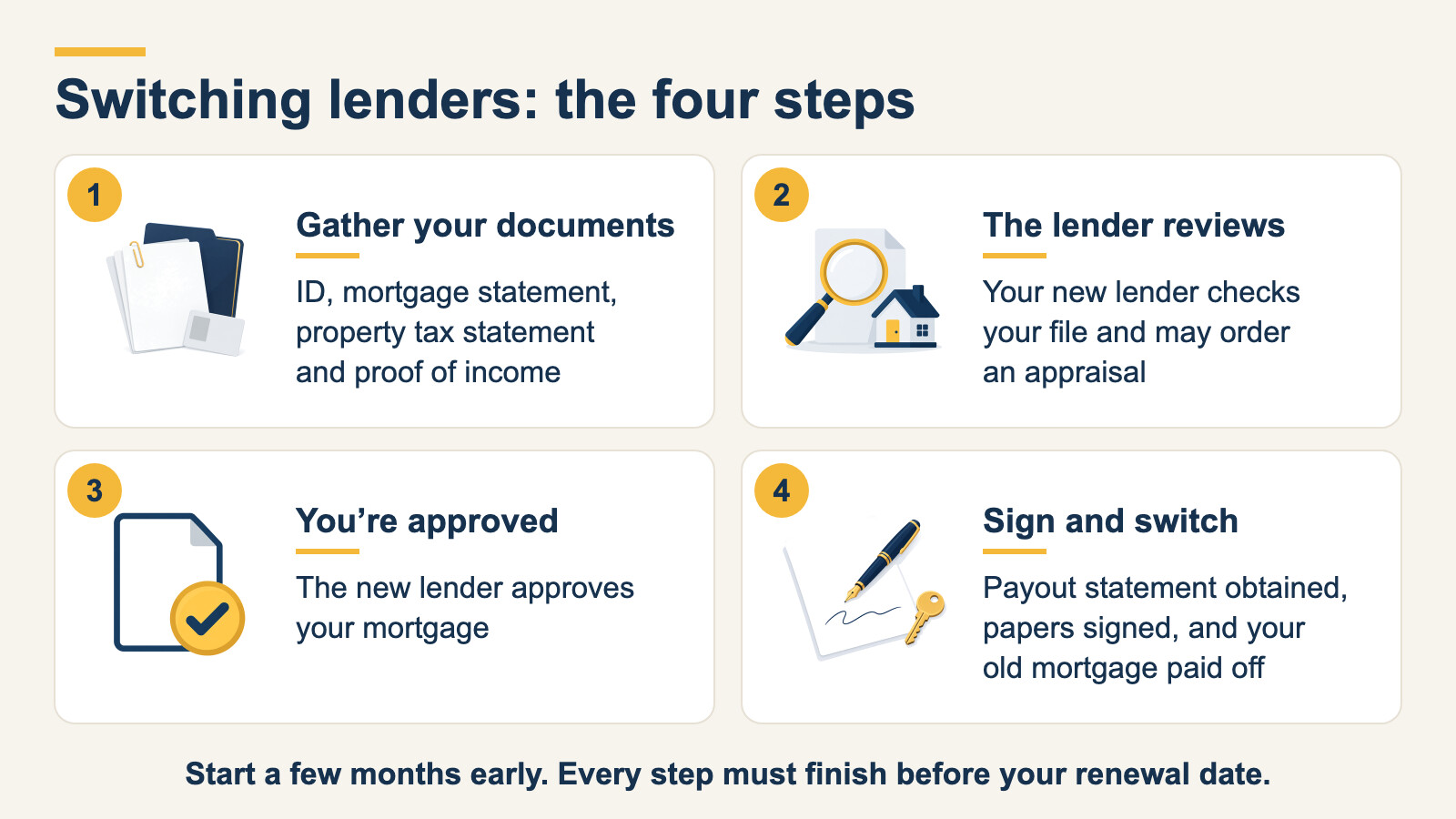
A few months before your term ends. A switch has four steps, and all of them have to happen before your renewal date:
- You gather the documents in the table above.
- The new lender reviews them and may order an appraisal.
- The lender approves your mortgage.
- A payout statement is obtained from your current lender. You sign the papers, sometimes with a lawyer. The new lender pays off your old mortgage.
You don’t need your renewal letter or every document to get started. We can go through what you have and check for anything missing before an application is submitted.